Syros: walking back in time

Last Friday we set off on a walk so it ended up creating its own nickname “extremehikingfridays” which obviously lends itself to some funny hashtags! At first didn’t mean for the day to be completely absorbed by a hike, but as we were enjoying exploring so much we ended up doing a full loop back to Kini, around 20k in total. Extreme-hiking lived up to its name!

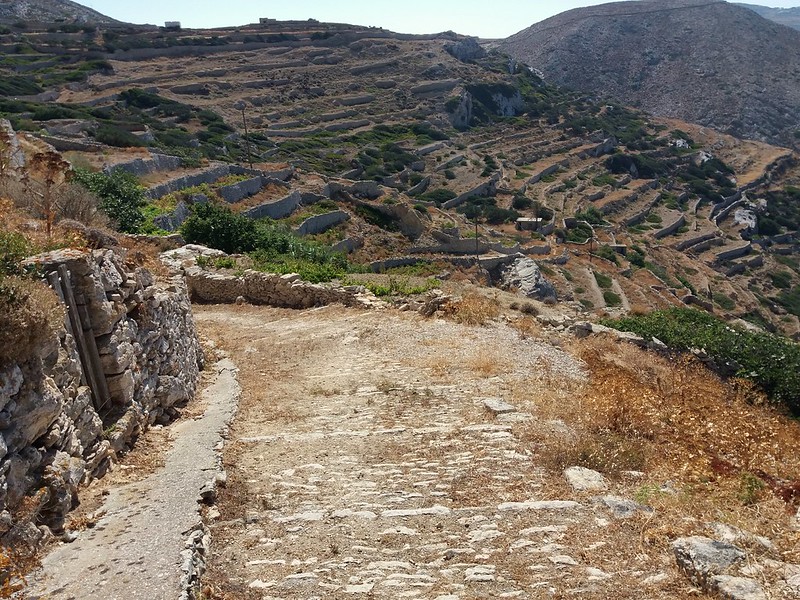
We set off on the first bus from Kini to Ermoupolis at 9am, with a packed lunch, fruit and snacks and plenty of water to keep us hydrated. The route chosen would take us North out of the town, passing tiny hamlets of Richopo, crossing into Ferekidh’s Cave, up to the original settlement of Kastri and then onto the excavation site of Chalandriani. This combined a few of the existing trails mapped as 1, 2 and 3 which we thought gave us plenty of options for finishing it up with either a taxi or walk back to Ermoupoli.

The weather was warm and breezy, so not too hot for walking. But the first section was the ascent through Vrodado and the steps nearly defeated us!

20170827_114423

This leads up to Anastasi which is known as the Church of the Resurrection of the Savior. This blue domed Orthodox church sits astride the hill, opposite the hill top of Ano Syros where Agios Georgios the Catholic Church holds court. Anastasi is dedicated to “Resurrection of the nation”. Built in 1874 by the local architect Dimitris Eleftheriadis, it is very impressive with a mix of Byzantine and neoclassical elements. Once past the 200 step climb we set of walking out of the town through an area called Dhili. Here the houses are a mix of very old and newer constructions, and as you leave the confines of the urban area they start to have more land for agricultural purposes. Once we reached a Panacrandos Church, this is where the path of trail 1 started – the path is well marked and views here are spectacular.

20170818_104237

https://www.flickr.com/photos/144180115@N07/36027032703/in/dateposted-public/

Outwards over the Aegean to Tinos and Andros, taking in Cape Armonos and Agios Demetrios which is the byzantine church looking out to sea and spectacular if you get to pass it on a ferry.  After a while on this barren stone path, we came across a tiny hamlet of Richopo where there are signs to Ferekidh’s Cave (or Pherecydes of Syros as he is also known). A philosopher known as one of the Seven Sages of Ancient Greece, his work contemplated the importance of time (chronos) by using a heliotrope (sun-dial)  village of San Michalis (yep where they make Syro’s famous cheese).  but there is a bust of him in Ano Syros as well. His philosophical musings discussed metamorphosis and the underworld, as well as teaching Phythagras.

https://www.flickr.com/photos/144180115@N07/36439737560/in/dateposted-public/

Pherecydes was a complex character and very little of his written work remains – Scholars disagree on his work so this could be why signs point to his cave, yet the cave doesn’t receive historical site protection. This possibly goes some way to explain why the powers that be decided to build the municipal dump and recycling-centre less than a mile downhill from it! Which has sadly resulted in a million plastic bags are carried away on the wind from the dump and end up littering the amazing path around the cave – this was just such mess and made me pretty angry.

20170818_112026

You get plastic bags with every single purchase here. It would make a huge difference if they’re use was reduced and the authorities did more to protect the rubbish from blowing out of the site and ruining the island. Rant over!

You’ll see from the pics, it is an amazing cave. A real place of contemplation and solitude.

20170818_113726

IMG-20170818-WA0002

From here we scaled inland to Plati Vouni, which is a rural settlement of themonia (houses) closely built together – many households still work on the land, keeping goats and chickens, bring water up from the wells and natural springs. We even spotted a few circular threshing floors as well, although at this time of year all the hay and wheat had been collected. Apart from electricity cables this area would have changed very little in the past 50 years, being very similar to Folegandros and other Cycladic rural villages we have walked through.

20170818_122754

Passing down through a valley we headed out to coast again on route 3, losing our way slightly as we were following this immensely valuable description of the walk. Reaching a lonely house, then the trail leads down and out to the headland to reach the remote beach of Ghilsoura. Even though remote, without a road to it or electricity cables, the house was occupied by a Greek family enjoying a drink on their terrace. We misjudged and took the turn too soon – luckily the family realised what we had done as we tromped through their land, and started waving and pointing us towards the right path! We exchanged pleasantries and thanks. If it wasn’t for their intervention, I am not sure where we would have ended up.

20170818_130433

20170818_131802

The beach at Ghilsoura is magnificent and remote, with pristine pebbles lining the shore – we took a dip here and enjoyed our picnic. This would have been one of the two beaches invaders and pirates landed at when the only settlement of Syros was at the Kastri. We looked around at the back of beach where the trail was meant to rise up to the Kastri, but the path is almost completely hidden! It doesn’t make itself known until you are right infront of it and see the red arrows marking the path. The Kastri rises from the top of the summit making it the perfect place to spot any threats and by time any invader reached the top, they’d be tired!.

20170818_141646

Dating back to the Early Cycladic period the Kastri would have been not only a fortress to protect the islanders, but also a village where the daily ritual of life went on. There have been numerous excavations over the years including the discovery of the Acropolis area at the top of the site and a graveyard with about 600 tombs. Some of the ceramic vases, stone and metalwork fragments are held by the Syros Archaeological Museum and reveal it was a sophisticated society.

https://www.flickr.com/photos/144180115@N07/36439749070/in/dateposted-public/

The climb to the top reveals its charms and practicality – no pirate invader could make it to the top without being seen! The views from up high are its main vantage point – out to sea and inland across the island. To get a real explanation of the Kastri’s scale I found a good photo here . When you are exploring it you don’t get the full sense of its scale so was good to see that aerial image beforehand and wander round accordingly.

20170818_142208

Here we came across 4 fellow walkers which is a rarity on our travels. These Greeks asked us where we had walked from and were surprised to hear we walked all the way from the town (rightly so as we’d already done 8k!) They had parked their car at Chalandriani and walked over, which is a steep 30 minute which does make the site accessible for even non-walkers. But I found walking there past the smaller hamlets first gives you a better sense of the variety of landscapes on this compact island.

After this we scaled uphill to Chalandriani which is also a small settlement and site of a large excavation. A few houses remain occupied here and terraced land dominates the view.

20170818_154523

The excavations in Chalandriani started in the late 19th Century by archaeologist Christos Tsountas  and the findings from the village are considered one of the most important in Cyclades. Figures and pottery from this site are displayed across the world on loan from their home in the National Museum in Athens. I even managed to see some pieces from Chalandriani in the Ashmolean Museum on my last visit to Oxford. So it was great to see the site they came from – although there isn’t much to actually see here.

From this road junction where the trail 3 ended, we made the epic decision to walk back to Ermoupoli, but heading on an alternative route back that passed the settlements of Kiperousa, Senero and Finikia. Although this cut through on the road this is a stretch of the island that is fairly quiet especially mid-afternoon.

20170818_160909

Once you reach Finikia, this is a few old abandoned houses and newer farms which would have been in a valley, possibly with a Spring to supply irrigation. It has the tell tale signs of a seam of lush green trees growing through the middle of the valley. It was blissfully quiet and at the same time has a ghostliness quality to it, as you walk past you can imagine life in the abandoned 19th Century dwellings and mules using the paths marked by dry stone walls. All of the paths which wind up and down would have carried goods and livestock to the markets of Ano Syros.

20170818_165914

20170818_164832

As the road corners towards Ano Syros this area is really interesting as it still has the remains of windmills. One has been kept intact and sits proudly overlooking the valley. But its doors are locked and marked by a sign saying it was restored by the Municipality. We took the steep path up to the peak of the hill where the remains of three windmills stand and then on to Alithini.

https://www.flickr.com/photos/144180115@N07/36836057605/in/dateposted-public/

The views here are breathtaking – from it you get a sense of all the histories of the island merging into one modern personality. From the medieval settlement, growing and expanding through the 18th Century in it’s industrialist heritage. Ermoupoli stretches out as a meeting place of both its the rural and urban populations, defined by many people who came as immigrants, changing the islands fortunes, religion, cuisine and culture.

20170818_175642

In Alithini, we found a path marked trail 10 which would take us up over the final hill, past the out of action wind turbine and down into Kini. This path is one of the sparse remains of the original path network that even up to the 1960s workers from Kini would have used daily. It has two options; Alithini to Kini or heading up to Aghia Varvara and then turning at Piskipio and down into the shipyards and factories of Ermoupoli – a route of 8k each way. Imagine that as a daily commute to work!

During the Italian occuoation of Syros in the Second World War, as vehicles were a still a rarity on the island, Italian soldiers would have used the old path network to solicit food from farmers and transport goods by mule. As you walk these routes which connect villages and churches on worn cobbles and marbled stones, sometimes with carved steps and bare earth, it impossible not to imagine the lives of those Syrians who walked them everyday.

By the time the sun was low in the sky we reached the bay of Kini. There was only one option, taking our aching legs and heading straight for a rewarding beer !

#extremehikingfridays watch this space for more adventures!


Kea: trip report

I’m not always supremely confident on my own. Like most people in a group situation I can hide with other people. Just me on my own can be hard to get used to. The internal monologue going all over the place with the little voice of fear and doubt! But I like my own company, I enjoy being alone – not lonely, but happy on my own. Making all the decisions alone doesn’t happen as often when you are part of couple. Especially when you are one half of an indecisive couple – ‘shall we eat here? shall we go there?’ – we both respond with the ever-placid “I’m easy – whatever you’d prefer”. So when G got whisked off for a week, I was faced with the prospect of being left to my own devices and decisions! I initially thought eating a lot of cheese would be high on my agenda, but after thinking about it properly I saw this as an opportunity to do some solo travelling, a vacation with myself. Genius and still likely to involve at least making decisions involving Feta!

G was asked to go on a Paths of Greece mission to uncover some old paths in the north of the mainland, and with this time I wanted to go somewhere in the Cyclades that was simple to get to. Narrowing it down was a case of studying the ferry timetables. I chose Kea because it has some really scenic countryside as well as lots of hikes, museums to visit and bays to swim laps in, pretty little streets I can get lost in, and coffee shops I can write in…Oh I’ve just described almost everywhere in Greece! On Friday I waved G off on his internal flight to Thessaloniki, from there he was heading on the bus out to Kozani in the Western Macedonia region, all set for a big week-long hiking adventure to discover old trails and map out a hiking network. Our neighbour Niko lived in Kozani and gave G a pep talk before he headed off, explaining how in the winters it would take 6 hours to clear the roads to get to the factories, with vast coal mines and power stations that supply most the country’s electricity. From our conversations this week, I have heard some crazy things that G has experienced; from wild dogs, to goat farmers and even deer living in monasteries, they all deserve their own tales. It’s a fascinating region of what deserves to be called ‘real Greece’…If you follow him on Instagram you’ll know what I mean!  If you’d asked me 12 months ago would G ever get involved in something like this, hiking 12 hours a day and adventuring round with the Paths of Greece guys in a beat-up jeep, I would have said ‘NO WAY’. He’s proved me totally wrong and is a legend for it.

So he’s doing hard work for a good cause and I get to take myself on vacation. I appreciate the very speed at which time flies and these six months in Greece are no exception, so not wanting to forsake a missed opportunity I book a trip to Kea, one of our neighbouring islands.

It is a different type of island – yes, part of the Cyclades in name but not in style. As it’s very close to Athens, with regular boats from the mainland port of Lavrio, I hear that plenty of wealthy Athenians have country homes there and that it gets busier on weekends and especially in August when most Greeks take their holidays. Luckily I’m going there mid-week in July, eh? I wanted to stay in Ioulida (or Ioulis) as it is one of those classic Chora towns perched up high, but has none of the Cycladic white and blue houses we associate with these islands, an altogether different architectural style, more medieval and neoclassical with red tile roofs. In fact is seems to have more in common with northern Greece visually, and it has a similarity to towns I’ve visited on its neighbouring island, Andros.

It’s super tricky finding a place there normally, nevermind when you decide to book a few days in advance. There isn’t any hotels or apartment complexes in the town, although it looks like more are springing up along the beach areas and in the port, so I resorted to AirB&B. I have been having a bit of a moral dilemma about this recently, especially as this model is having negative effects on rentals for long term tenants. This is being felt especially in Athens, where subletted apartments are changing hands for a cheap amount, then AirB&B landlords are raking it in on a per night basis. Do the math, if you can get a basic apartment on a 12 month lease for 300euros per month and charge 30euros a night – there is serious (tax-free) cash to be made.  Now these kooky apartments in run down areas being tarted up cheaply for AirB&B, may have been the ones young people would have been renting, artists, creatives, you know the lifeblood of a city before gentrification kicks in? Imagine if Airb&b had been around at this scale when Hackney and Shoreditch was on the rise…who would have been able to live there? The sad fact is the sharing-economy is turning areas of cities into ghost-blocks of apartments packed full of short term tenants, while young people, who have been hit hard by the economic crisis are unable to snap up a cheap apartment. Like other cities, this has been cottoned onto by the Greek government who have only last week announced a taxation regime to combat the 3 million visitors estimated to be staying in AirB&B’s in 2017. Sadly, unless these lettings get included in tax filing, the only ones who benefit from the extra income are landlords and Silicon Valley profit margins. Anyway, I can see it both ways  – the Airb&B model works because it provide spaces to stay where there isn’t a hotel or tourist infrastructure – so a local renting a room out, as has been done for decades in Greece, very much meets this demand. For a fairly small island but regular connections to the mainland, it doesn’t get a ton of tourists. It has a steady influx of Athenian homeowners and families who have second homes there – so has enough hotels and apartments to meet the tourists it does attract. But I wasn’t having any luck on the regular websites and agencies and am certainly not in a position to pay over 100 euros for a room that I’d need a car to get to! AirB&B delivered the goods at a budget price, so this time it wins.

2017-07-26_05-40-32

On the whole solo travelling is expensive, there’s no one to split things with (and share plates – yep, food portion problems!)  Hopping on a ferry at Syros was simple and I managed to tie in the times to the Hellenic Seaway’s Artemis boat on its regular inter-Cyclades loop – it’s slow boat and seems a bit more of a stinker than usual ferries. The engines pump out their fumes just above the outside deck where the seating area is and I always like to be out on deck if possible. Having travelled from Andros to Syros on the Artemis last year, I knew what to expect. It was a quiet and serene journey, the sun bobbing down into an orange glow just as we sailed past Kythnos. I shall rename it a sunset cruise, complete with Spanakopita for dinner. With the sun setting and the meltimi wind whipping my hair into my face, I thought life doesn’t get more glamorous than this!

As anticipated the Artemis travels to its own timetable, not uncommon for it to steadily build up a delay of hours over the course of its 12 hour inter-island loop. By the time I’d read for a while, spied on all the other passengers, stared out to sea and texted a few friends we had reached Kea by 11.30pm, close to 2 hours late. But my kind host, Irini texted to say she’d be waiting and not to worry. Phew, my next focus was the taxi I needed to get from the port Korissia up to the Chora where I was staying (Chora and Ioulis or Ioulida are interchangable names for the same town). As the ferry disembarked I focussed on where the taxi’s were waiting, after our experience at Andros last year, when we faltered at the taxi rank, then were forced to wait ages and then share one. I now make no apologies for being Greek about this – just get in the first taxi you see, any hesitation and looking for a queue is far too British. ‘Snooze you lose’. I was only carrying a small rucksack so sloughed straight into the first taxi, beaming “kalispera, sti Chora, parakelo!” as I landed on the back seat. ‘Ah, yes, no problem, please wait while I see” (this is something I’m used to now, I try to speak Greek, you hear my Greek-lish accent and reply in English- endaxi) He wandered up and down the disembarking passengers for a minute to see if anyone else was heading the same way and then headed back, resigned he wasn’t getting any other fares on this one. Sharing a taxi to the same destination is common practice in Greece, the difference being that all parties still pay the same fare, rather than splitting the cost…might not make sense to us but is very accepted practice here. As he hurtled up the dark hillside road, windows rolled down and dance music blared (that Rhianna track, Wild Thoughts, it’s everywhere, right?) I immediately noticed the smell of pine trees heady in the air which was so fresh and different to the smell in Syros.  Arriving at a new town at night alone can be a bit daunting but I saw Irini waiting as I got out the taxi, she was really sweet.  As it was a bit of mission to get to the house, through stepped streets and cobbled pathways winding upwards, we were both chatting away and getting out of breath! As we passed a few tavernas and cafés people greeted Irini, so it felt nice to be here with a local. She explained she works in the bakery and yes, she left delicious biscuits and cakes in the kitchen for me! The little 1 bed place was perfect, all whitewashed walls, and up-cycled antique furniture, and most importantly a view over the town. As it was late I just sat enjoying the view of lights twinkling below and people wandering around in the cooler evening air, before getting a good night’s sleep.

2017-07-28_04-25-44

I awoke early and was astounded by how beautiful the view was in daylight, the red terracotta roofs and all the houses a jumble of pinks, whites and stone hues. Each little building entirely different from the next in size and stature. The view spread out from the town all the way down the valley with its stepped terraces to the coast. The sun rises behind the village and because of the shape of the town built like an amphitheatre you hear the bells from all the churches, people waking up, opening shutters and chatting in the traffic-free streets. After enjoying a coffee (and biscuit) on the balcony, I felt like I needed a real introduction to the Kea and ventured out to explore before it got too hot.

2017-07-26_05-42-56

Although I was convinced I might have to leave a trail of cake crumbs to find my way back, I was too busy chatting when I arrived to notice where we were heading! But I soon got my bearings, down to the plateia and the impressive town hall building, finding a supermarket and buying some essentials to get me through a work day. That’s the beauty of being laptop and phone based, I can quite literally work anywhere with the internet and phone signal.

2017-07-28_03-51-54

After a day’s work on a super comfy chair and desk set up, I headed off to find the elusive Lion of Ioulis as the sun was low in the sky. Legends tell a few different tales about why this Lion has been carved from stone – some say it was carved as a reminder of the wild lions which once roamed in the countryside, others say it is a temple to remember the mimic tale about Kea’s origin as the island of water, known as Ydrussa and had a beautiful population of water nymphs, because of its beauty the Gods were jealous and sent a lion to destroy everything and the island dried up. Then to make it sound even more bizarre, as are most myths are with a twist, the islanders then begged Apollo’s son, Aristaeus for help, and built a temple to Zeus – the leader of all gods. This pleased them all and Zeus brought rain back to the island – therefore the Lion statue is a timely reminder of destruction and fate from the Gods. Perhaps that is why he seems so wise and weird!.

2017-07-28_03-54-03

I didn’t know all of this before I set off on the easy and well signposted 20 min walk from the centre of the village, but read up about it when I arrived. The lion is meant to date back as far as 600BC, yet signs have 1963 engraved on them protecting the surrounding space, with a gate and some whitewashed steps. So there must been a decision at some point to turn the lion into a tourist attraction. You do feel an eerie sense of stepping back in time on this walk, as you exit the village and past a few abandoned houses, it turns into just a cobbled pathway, past an impressive church and graveyard full of white marble statues to honour the dead. The lion sits surrounded by stepped terraces, a few donkeys and goats in the fields. It was a real place of solitude on an evening, apart from the animals, I didn’t see another soul.

https://www.flickr.com/photos/144180115@N07/36036445972/in/dateposted-public/

After such peace, I headed back into town to be amongst other people. I’d decided to take myself on a date for a drink after sunset, and then dinner in the highly recommended ‘Piatsa’ ran by a man called Yainnis. It’s the first place you come to through the ‘entrance’ to the Chora, only 8 or so tables outside and known for being good value local dishes. I happily sat in the midst of things. They were showing the football on the TV, so in between the taking orders, all the blokes from the taverna and the neighbouring cafe kept popping in to see the score.  A lively place as people met and took up tables, I enjoyed watching people pass while I sipped local red wine (not bad), sweet tomato-ey veal stew and an all important horiatiki salata , with Feta, of course.

2017-07-27_07-58-33

That’s the problem with eating alone, normally I’d have shared a side or starter, mixing and matching dishes to try things – I stuck with two dishes and it probably was a little bit too much. It was a great evening, I more or less was left alone to enjoy my own company, after all a female wearing a wedding ring wouldn’t exactly be the first person people would speak to. The waiter /owner was kind and even humoured my ordering in Greek. I’d highly the hearty food. I was alone but certainly didn’t feel lonely at all.

2017-07-27_07-53-47

The next day I wanted to try out one of the hiking trails and Route 1 seemed the easiest as it started in the Chora and ended at the beach in Otzia – which would be a perfect spot for a swim and lunch, before getting the bus back. I wanted to have a look at the Archaeological Museum first before setting off and I’m really glad I did, as it was my only opportunity because it is only open 8-3pm. At a bargain 2Euro entrance fee it is well worth a trip, on two floors it holds a fine collection of artefacts from various excavations on  the island. Of particular interest was the statues found at Ayia Irini near the port village of Korissia. These 60 + fragments of Neolithic Goddesses or ‘Sisters of Kea’ as they have been called, were found a temple and have been the subject of much mystery. They are ranging from 6ft in height to smaller versions, large bosomed, mostly headless and wearing skirts and necklaces. They are quite a striking collection and I perhaps gave them extra gravitas as I’m reading The Power by Naomi Alderman, a rather dark and violent alt-reality about the shift to a female-centric society. If you’ve read the book you’ll know what I mean, if not – READ IT! These Goddesses certainly got me thinking that there could have been whole tribes of people in early civilisation that not only worshiped goddesses but were led and governed by female warriors.

2017-07-28_03-52-41

Inspired by all that I grabbed a delicious tyripita (cheese pie) from the bakery, loaded up on water bottles and set off on the trail. I really enjoy walking on my own as it gives me plenty of time to escape the chattering mind and get out into nature – although I do walk with a ‘spider/snake-stick’ which means that if you see me from a far I appear to be either brandishing a magic wand or blessing the path in front of me like an ordained priest. Really, I’m just waving the stick about to prevent me walking into cobwebs…ugh, I think (and hope) snakes are too lazy in high summer to attack! The paths were well marked and took me down from the Chora, past the Lion again and onto the spring at Veniamin which is a huge area with a marbled plaque and rows of drinking troughs. The Spring is still active and there is a huge oak tree for shade, from here the path is cobbled and flanked by dry stone walls and trails gently downward into the valleys.

2017-07-28_03-53-43

Originally this path would have connected the town to goods and traders ships which came in at the small inlet of Otzias. After nearly 2 hours walking (and no spider interactions – just a cricket flew into me and I yelped) I reached the beach – I hadn’t passed anyone apart from a woman on a donkey, presumably heading into town on her trusty steed.

2017-07-28_03-55-59

Some aspects of Kea really surprised me with its traditional ways, like donkey’s still being used for transport and the quietness of village life still going on in the same way as it has done for decades, despite being so close to the mainland. There is also a stark contrast such as the number of new build houses dotting the landscape once you head out of the valley, which made me feel a little sad when so many gorgeous building lay in need of repair in the Chora. But like everything, you can’t stand in the way of progress, especially when the country is still recovering from the economic crisis, although this week saw the reintroducing of Greek Bonds, a first since 2014 and some say a sign of a return to growth. I really liked the beach at Otzia, gravelly near white sand and shelving calm sea, sun loungers at one end and free benches at the other. The beach has a few apartments and hotels scattered around it, all fairly busy with a mix of mostly Greeks, French and Dutch. After a swim and sunbathe  I treated myself to a salad for lunch at Taverna Anna and sipped Fix beer in the shade while I waited for the bus back up to town.

2017-07-28_03-55-02

In addition to spending some time in Kea writing, I also wanted to keep practising my photography skills – amateur at the best of times, but G lent me his decent camera so I spent a couple of hours wandering the streets snapping away at decadent ironwork, abandoned houses and doorways…a growing obsession with the decaying grandeur of neo-classical buildings. Luckily Syros is prime hunting ground for such palaces, so I expect this interest to grow.

I spent my last night on Kea watching the world go by from the comfort of the outdoor seats at En Lefko on the main street. The town isn’t over-crowded as such, but does fill up after 9.30pm when people start taking up tables in the tavernas. I bagged a spot in the Kalofagadon restaurant overlooking the picturesque town hall. Enjoying another excellent dinner, this time tasty lamb chops and horta, followed by watermelon. This also scuppered my plans of having an ice-cream on the wander back to the house! I mean, what kind of holiday doesn’t have ice-cream factored in as a daily activity! Tsk – I had let myself down!

The next day I had blind faith in the taxi I had ‘booked’ by chatting to one of the drivers in the square, as the time crept on, 5 minutes ticked into 10 and I considered my options; 1) miss the ferry back to Syros – costly, 2) wander over to the table of men in the café and beg for a lift to the port, and before I had time to think of a third, my trusty steed arrived, no not the taxi driver I actually made this arrangement with, but the one who I met when I arrived. Phew! And before I knew it there I was back on the Aqua Spirit with a breakfast of Spanakopita, from Korissia’s traditional wood-fired bakery and a freddo espresso to enjoy on the journey back to Ermoupoli.

For those of you who pay attention, yes, I did have 3 pastry based meals in 4 days – don’t judge – I also could have had WAY more cheese.

Sadly, that might be my last Aqua Spirit journey as the boat is due to retire at the end of the month – I asked the ships purser when it was changing to the new boat (the ex-, he was vague “next month, sometime”. But having travelled on it quite a bit this summer, I was pleased to get the nod of recognition from the crew. They walk around the ship when it gets into each port to make sure the lost tourists get off at the right stop. At Kythnos he did his usual walk through, looked at me and said “Syro, neh?. I smiled ‘Neh, Syro’, and kept that smile long enough for the boat to reach Ermoupolis and see its twin hills swing into view. There she is, the Queen of the Cyclades and thought to myself, ‘home’…

2017-07-28_04-25-24

Folegandros – trip report

2017-07-14_03-40-04

Arriving on the ever-reliable Aqua Spirit from Syros into the port at Karavostasis (which I think literally translates as Boat place) is a little underwhelming, one can’t really believe this is it…

2017-07-10_09-58-01

Just 2 rows of old and newer buildings, a small bus shelter and the port police station. Then your eyes scan leftwards and see a tiny beach, all white pebbles and aqua blue sea. No sunloungers in sight, just a few tanned bodies and children jumping in the sea. Bliss!

2017-07-10_10-02-10

We had arranged to stay in the Chora, which is the main town 3km from the port. On an island that is 32 square kilometres and only has three settlements, visitors to the island are clearly wowed by how tiny and barren the landscape feels. We took the trusty island bus up to the Chora,  1.80E a journey and runs every hour or so in peak season, you can see how this is a perfect island to explore on public transport and by foot. Despite this, there numerous mopeds and cars hire places around should you want to, but I did hear that there is still only 1 or 2 taxi’s on the island. It seemed that most hotels and apartments run their own little shuttles picking people up at the port and back to the Chora or the second inland village, Ano Meria.

https://www.flickr.com/photos/144180115@N07/35791663446/in/dateposted-public/

I can’t really claim this island is off the beaten track anymore – that might have been truer 10 or 15 years ago, just on the fringe of discovery. But now it’s a bustling place that is evidenced by several new build all-white-boutique-hotels (I have been an observer of the personality-free phenomena in Greece for a few years now – it starts off all white washed, chrome fittings and bleached wood peppered with Instagram-style marketing and tanned bodies). Quite frankly I think it may be a regrettable trend that says nothing of the true eclectic personality of Greece. Blame the Mykono-isation of tourism, ‘build it posh and they will pay’ from Marbella to Amalfi these styled hotels are everywhere. I hope that most travellers to Greece seek something more laidback, a place that tells of history, the land and most importantly its people. Folegandros is a beautiful island, it’s streets are full of colour that juxtaposes the light and shadow, the aquamarine sea, and white pebbles, blue shutters, dark wood and terracotta. You see this on the cobbled streets of the Chora.

https://www.flickr.com/photos/144180115@N07/35785039941/in/dateposted-public/

2017-07-14_03-41-21

Once the bus had dropped us off we easily found the Anthia Hotel, over the road from the local government building and bus station. We were welcomed into a simple but very clean double room with a ground floor terrace. We were lucky to book a room in advance as we only found this 2 weeks ago, and struggled to find anything for less than 80E a night. The Anthia is a family run place, close to the entrance to the Castro and one of several recently built smaller hotels near the entrance to Pounta Square. Although no stunning views to speak of, I was placated by having plenty of bougainvillea and terracotta pots over-flowing with greenery on the hotels terraces. That is one of the thing that struck me about the island was the sheer dry barrenness of the rocky landscape. The Chora sits 200 metres above the sea perched  in its whitewashed splendour and domed churches, yet below are terraces and miles upon miles of drystone walls that criss-cross boundaries across the horizon, spiraling downwards into the turquise Aegean sea.

2017-07-14_04-01-49

It is almost unfathomable how this land was once cultivated with terraced vineyards, olives and arable land, not to mention the time it must have taken to dig out terraces, and build all the dry stone walls and stone paths that still remain connecting the islands beaches, churches and farming hamlets. Like it’s neighbour Sikinos there is a very raw beauty to this place that hasn’t been changed too much yet by tourism and I hope it stays that way.

https://www.flickr.com/photos/144180115@N07/35443844120/in/dateposted-public/

Folegandros appealed to us because of the hiking and the opportunity to explore the villages on the island, Chora and Ano Meria do not disappoint. Chora has a wonderful part of the village with the original Castro (Castle) settlement with its little rows of terraced 2 up 2 down houses – some of which are restored as little houses and some lie abandoned, but this gives a nice mix of life, colours and flowers. You can still see village life going on as it has done for centuries. Just wandering around the village in late afternoon or early morning is a wonderful quiet experience when the shops are closed and just a few people sit in the cafes and taverna’s in the main squares drinking coffee and playing tavli.

2017-07-14_03-50-45

Also like many places in the Cyclades the sunsets are something special and many people walk up to the Panagia church, up an easy 20 minute winding path at the highest point of the village to enjoy the view. After this nightly phenomenon the squares come alive and people jostle for the best table at the bustling taverna’s. It is as if hundreds of people descend on the village from nowhere! But its good to see tourists in such droves, we noticed mostly French, Scandinavians and Italians were there in July.

2017-07-14_03-40-56

The food we enjoyed was matsata, a local pasta of thick deliciously soft ribbons usually served with sweet tomato stew usually with goat, rabbit or rooster. (I enjoyed goat matsata thoroughly!) Most taverna’s brought over caper dip with bread; a delicious salty spread, perfect with olives and cheese.  The islanders are also famous for a soft cheese known as Souroto, which is similar to other local cheeses I had tried in Naxos and Sikinos, each islands gets its own unique version. Luckily the island’s bakeries make delicious cheese pies with Souroto, which are almost foldover pasties with courgette, onions and seasonal herbs like dill and mint. The daily trip to the bakery before we set off on hikes provided tasty and portable lunch options.

2017-07-14_03-37-35

We did two big loop hikes while we were there; the first being from Chora to the beaches and back, we set off at 10am in fairly warm but windy weather, down out past the old well and spring under the cliffs. This part would have been all terraced agricultural land and still retains much of that character and wonder as you wander through.  Once reaching Agios Savvas and crossing over out to the three old windmills above Vorina beach – which is marked as Trail 1 on the ever reliable Topo Map of Folegandros. We decided to make this into circular route by veering across an old trail which was only marked by red dots but curated excellently on this website here

2017-07-10_10-07-28

This trail then took us past the Angali road and up over the hills to an abandoned settlement of Giorgi t’Aga, with the most impressive wild cactus just sprouting free in the middle of an old house. This route didn’t seem as well trodden as we spent time picking our way past overgrown dead plants and weeds. It then joins trail 2 and veers gently down to Agios Nikolaos beach – once an uninhabited hippie beach, now has two tavernas running off generators and people arriving on boat trips. We stayed to swim and eat lunch, having that dreaded conversation no one wants on a day long hike; “Have you got the suncream?” “No, I though you packed it?” then realising it is hanging in a plastic bag back in the hotel room. Yet we had supplies of water and food to last all day, but no way of reapplying suncream! I great fear of my northern skin, I stuck to wearing a cap and tshirt for the rest of the day!

https://www.flickr.com/photos/144180115@N07/35107837053/in/dateposted-public/

After enjoying this beach we set off along the well warn path that connects the string of beaches, Galifos with its rooms to rent with no electricity and on to Angali. I understand this was once just a small beach and now grown to a small collection of places to stay and taverna’s, although there isn’t a shop or kiosk, there is bus connection to Chora. We stopped in at the near empty Fira beach for a swim, before starting the late afternoon ascent back to Chora via Christos Church. All of this section is marked on the path with regular ‘FI’ letters (for Fira), so makes it easy to follow back to the main road, although tiring and steep.

2017-07-14_03-42-39

Once on the main road we went past Stavros Church, which has a phenomenal balcony perched over the road. Feeling quite sun-beaten and weary we chose the road way back to Chora – which isn’t terrible as the traffic is fairly sparse and some people still travel by donkey here. Rounding off the walk with ice-cold bottles of Fix beer in a shady café back in the Chora…a good 14km in total meant that that night’s hearty  dinner was well earned, as well as the shots of rakimelo!

Folegandros has plenty of routes to attract both casual and serious walkers, in fact there is decent selection of routes on websites by just searching as well as on marked trails on the Topo Map and a free map of Ano Meria which has a further 4 trails that start and finish in the village. It was actually one of the best served islands for options for walks we have been to for a while – although we didn’t see many other walkers but as it was July this was understandable. In Chora we noticed posters and a stall for a crowd funding campaign ‘Folegandros Routes‘  to formalise the routes and preserve paths, and eventually have architectural plans to build a huge 3km pedestrian walkway, for wheelchair and pushchair access from the port at Karavostatis to the Chora. This seemed like a very ambitious development and one that would require not just a vast amount of investment, environmental surveys and marketing to ensure the nature and character of the island remain preserved for the future. It will be interesting to see if this gets the go-ahead. It also feeds into my pet-peeve about Greek roads – if only there were built with pedestrians in mind, this would mean they can easily be adjusted for wheelchair access if the safe space was already there!

After a more restful day, we then got back hiking a 16km route. Starting with an early bus up to the end of Ano Meria to set out on Trail 5, which was also marked LV towards Livadakia beach. It descends down some incredible views, past ruins of themonia (farmhouse) settlements and distant churches. The quality of the paths and trails are also pretty good with old stone paths, cobbles and steps cut into the rocks. After about 50 minutes walking Livadakia beach is a real sight to behold as you near the cliff edge and it opens up to a spectacular aqua marine inlet and white pebbled bay – with giant 10 foot tall cairns build by some adventurous souls.

2017-07-14_03-38-14

We were’nt alone here either, despite not seeing others on the way – a couple of boats bobbed into sight and dropped people off. The beach doesn’t have much shade or any facilities so do come prepared. After diving in off the rocks into the cooling waters, we enjoyed a lunch of bakery treats and just-in-season nectarines. Once rested we set off and ascended the scary rock steps up the cliff face which despite my vertigo, weren’t as bad as they looked from below! The path then meanders around the hill inland before splitting to go to wither Agia Fotini or the lighthouse at Cape Aspropouda – we went to the lighthouse first as it looked so lonely out there. Built in the early 1900 it has a gothic almost Victorian era turret with a view over the cliffs. It has been unmanned since 1986 when solar powered panels took over from the two lighthouse keepers, since then in its been left in a state of mild neglect and the front shuttered window hangs loose. You can peep in and see old furniture remaining like museum pieces in what was once the bedroom. Pretty spooky and fascinating place to visit, and one imagines how cold and windy a winter night must have been out there!

2017-07-14_03-36-18

After that we hiked uphill back towards the village, over terrace hills and more recently used farmland. Once at Agia Fotina, there is an unfinished road which sadly must have destroyed the old path back to the Windmills in Ano Meria.

After a swift but well needed rest stop for ice-cream at the mini-market we headed through the village and out on the main road towards Vorina beach. Once at the start of the old trail, it gets very steep downhill, but the rocks have been cut into sharp steps so makes the walk do-able but tough. Apparently these were the old steps where mules would bring up rocks cut out of the cliffs for building all the way up to the Chora. This must have been painful and back-breaking work for animals and humans alike! The scramble is worth it as you reach a squally north-facing beach with huge waves and emerald green sea. We didn’t swim properly here but sat in the shallows letting huge waves cool us down and enjoyed the tranquility before preparing for a heart-quickening workout to get back up the steps!

2017-07-14_03-43-39

I’d certainly recommend Folegandros to anyone wanting to get off the beaten track and see a windswept Cycladic island that has developed sensitively in recent years, but doesn’t want to lose its traditional character and nature. As it attracts rather well-heeled types with its ‘boutique-hotels’ in high-season and we found all the accommodation to be a little pricey. But it is certainly a treasure to be explored and offers so much more than a ‘beaches and cocktails’ destination. I’d love to come back in Winter and experience the quiet time, which our hotelier described as “nothing to see, nothing to talk about…I walk through the town and see only cats”. I’d say it sounds perfect!

I’ll follow up with a piece on the wonderful Folk Museum we visited and some more highlights soon…

Small island manners

It struck me on Sunday as I went on a little walk to Delfini beach how people are a little kinder and helpful on a small island.  It was a little walk – it takes less than 25 minutes from to spiti mas (our house) to the paralia (the beach). Yet in that short amount of time 2 cars stopped to offer me a lift. I know what you’re thinking “stranger danger” and accepting lifts is so unheard of these days. This isn’t just because we have lost trust in our fellow humans and been programmed that everyone out there is set to rob or murder us, its endemic of how we fear things we don’t know. I was a woman alone walking in the heat of the sun.  I mean the path is hilly, there’s a couple of steep climbs as you near to the bend before reaching the bay – but I like to think in my sporty trainers and hiking backpack, I totally looked like a typical thing for me to do. But I think it comes down to the fact that it isn’t common to see people walking to the beach here – so a nice thing to do would be to stop and offer them a lift as it’s a dirt road that ends at the beach, you know anyone going in this direction is heading to the same place. When the first car stopped, I said a simple “oxi, efharisto” and he waved and went on his way. But when the second car stopped merely a few minutes later on the ridge of the steepest hill, I started saying no and he waved and smiled, then his slightly worse for wear car started struggling to keep going and started to splutter and stall. I thought, now if I have to help him push the car up the hill that will be just brilliant timing! Man stops to give woman lift on midday sun – and she ends up pushing his slightly worn out car up a hill like a superwoman. His ego would probably never survive!

2017-05-16_08-13-26

But that’s just a more chivalrous way of life here. I’m not saying I like it – it is just different and something you notice in the older generation more often. I was in the post office last week when an older man ahead of me offered to swap tickets. It has the same system as back home where draw a ticket from the machine and ait to be called. He probably made a judgement at my blonde hair and flip flops, realising my need at the counter would likely be a swift transaction to buy stamps, rather than his complicated pension forms or some other administrative red-tape that would take time to get stamped and approved. It was very kind of him and I thanked him in my best formal Greek.

Not that this happens everywhere, but it does happen more when I am without G, evidencing the lone female theory, but I certainly don’t have a free pass to universal  kindness! But I’ll certainly try to reciprocate it. On ferries, busses and ticket counters I have been shoved, pushed in front of and tutted at for being too orderly and well, darn-British for following a sense of THE QUEUING SYSTEM. The hallowed order doesn’t work here, it has no currency.

Anyway there is a sense of neighbourly kindness and community in Greece – I won’t make a sweeping statement and say it just so much better here, but it is different from what I have been accustomed to. At home having an elbow shoved into the ribs and overhearing the swearing pent up anger of fellow commuters was a good day in London.  Here it’s old ladies pushing to the front of transport and traffic jams caused by runaway mules. But I can forgive all of this – when I’m 70+ I want to be first on the bus too. It’s just mellower and friendly, it seems customary to speak to strangers, offer words of kindness or give welcoming gifts.

2017-05-16_08-19-31

Our landlord stops by with fresh eggs, an assortment of veg from his plot. He brought beetroot over and I made a delicious panzarasalata (beetroot salad with garlic and yogurt) I met the lovely Jacky and Flora who run the Syros Cat charity last week and somehow left with a box full of ripe strawberries. Well, at least fruit requires less responsibility than a cat! Our neighbours have left us bags of lemons which G made into Lemon Curd. I’m starting to worry that I need to return the favour but haven’t got anything to give! (well let’s hope the garden gets productive soon – the pressure is on!)

We are on the wonderful island Tinos at the moment. G has been here all week volunteering with Paths of Greece. He is walking an average of 20k+ a day to map out the paths. He’s having a great time. I arrived yesterday and have been taking it easy. Guiltily of course.

2017-05-17_12-26-32

I spent a while wandering the picturesque streets of Pyrgos in the north of the island while they were off hiking a trail. This is one of the well preserved and pristine examples of a traditional village whose main industry is marble. It has a great museum of marble crafts, which was sadly closed. But I managed to peek in to one of the workshops the students from the college were sculpting marble in.

2017-05-17_12-24-55

The main square is entirely made from marble slabs and has statues, hand carved adornments above windows and doorways everywhere and even the bus stop is made of marble.

https://www.flickr.com/photos/144180115@N07/34711899145/in/datetaken-public/

It is quite honestly the most picturesque little place to while away the hours – hardly any tourists around at all.

2017-05-17_12-24-09

After lunch I was pointed in the direction of a nice easy trail from Vlakos through the ancient boulders to Koumaros and back to the rural village we are staying in, Skalados.

After admiring the old abandoned houses in Vlakos, which have hand written memorials, poems and stories about their inhabitants, I set off along the road to the boulders.

2017-05-17_12-22-36

All of a sudden I heard an old lady calling me, from the churchyard I’d just passed. She was waving a broom at me and I was scared! What had I done, offended someone on a holy afternoon? After a few minutes of shouting Greek words at me, none of which I could fathom, all I could say was ‘then katalaveno – signomi’ (sorry I don’t understand). She then took the broom in her left hand and made a waving movement with her right arm and said in a French accent (most Greeks here seem to also have a grasp of French too as plenty of tourists visit from there) “Serpent, l ‘attenzione, serpent!” Now the penny dropped, she was warning me about snakes, that hand movement was a snake not a ‘rollin’ with the homies dance‘ which had thrown me! I replied, “Nai, Nai! Efharosto para poli” (yes, thank you very much) and I mimed back a gesture of keeping my eyes on the path. Phew! The lady was just being kind to me and letting me know there are snakes around. Yes, snakes. Another thing to add to my fears; heights, rabid dogs, spiders.

https://www.flickr.com/photos/144180115@N07/34550308612/in/datetaken-public/

Well at least I was warned, now I could be fully prepared. Well I’m pleased to say I enjoyed the walk and wasn’t victim of a snakebite (only very few are poisonous and they are the patterned vipers). I made it through Kamouros, admiring the sweet little honesty café they have there where people can help themselves to drinks and leave the correct change.

2017-05-16_08-12-35

That’s a nice neighbourly thing to do – creating a little place people can drop in and have a space for the community of 20 or so houses of the village.

These reminders of the kindness of strangers and trust are all things I am finding different here but certainly are welcome views of Greek life.